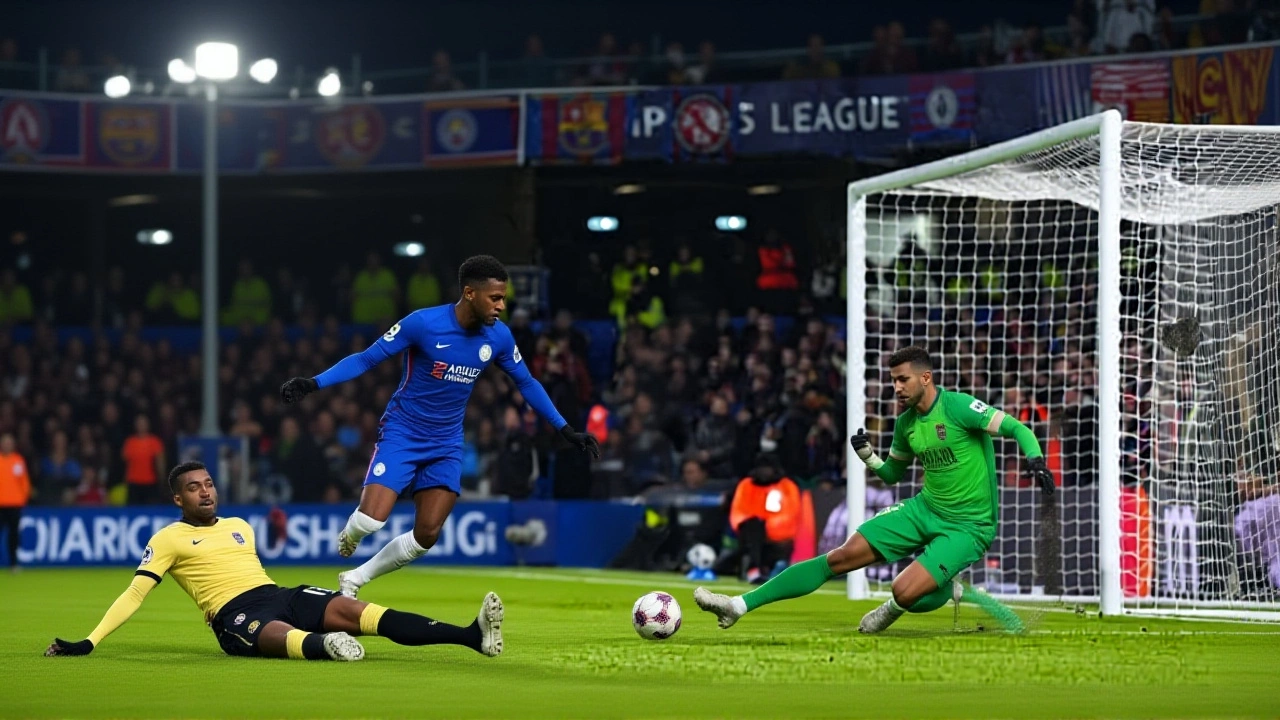
On a cold November night in west London, Stamford Bridge erupted not just for a win—but for a revelation. Chelsea Football Club crushed Futbol Club Barcelona 2-0 on November 25, 2025, in a performance that didn’t just win points—it announced a new era. The star? An 18-year-old Brazilian named Estêvão Willian, whose 62nd-minute solo goal wasn’t just a strike—it was a statement carved into the soul of European football.
The Moment That Stopped the World
It happened in the 62nd minute. The ball rolled to Estêvão near the right touchline, barely five yards from the sideline. Two Barcelona defenders closed in. The crowd held its breath. Then, in under six seconds, he did the impossible. A subtle feint, a sharp cut inside, a shoulder dip that sent one defender stumbling, then a second step-over that left the other grasping air. He accelerated. The goalkeeper rushed out. Estêvão didn’t shoot low. He didn’t go wide. He lifted it—clean, high, and pure—into the top corner. No spin. No luck. Just physics and talent colliding. The UEFA Champions League 2025-26 had its first iconic moment of the new format.“It was like watching a ghost weave through traffic,” said FOOTBALL VIEW’s match analyst in their uploaded transcript. “He didn’t create space. He invented it.”
A Statement Win, Built on Discipline
The goal was the exclamation point, but the foundation was laid earlier. In the 27th minute, Christopher Nkunku—Chelsea’s French forward—opened the scoring with a crisp finish after a slick one-two with Moisés Caicedo. Then, in the 38th minute, Barcelona lost a man. No official name was released, but replays showed a reckless challenge from the edge of the box. The referee didn’t hesitate. The away side, already struggling to control possession, suddenly had to chase the game with ten.Chelsea didn’t just sit back. They pressed. They suffocated. They turned Stamford Bridge into a fortress. This was their fourth straight clean sheet across all competitions since November 6, 2025. Against a Barcelona side that hadn’t lost away in Europe for 12 matches since April 2024, it was a seismic shift.

The Boy Who Changed Everything
Estêvão Willian wasn’t supposed to be here—not yet. Born in 2007, he joined Chelsea from Sociedade Esportiva Palmeiras in July 2024 for €34.5 million, plus €12 million in bonuses. His contract runs until 2031. The club holds an 80% sell-on clause. He’s not just a prospect. He’s a blueprint.His goal wasn’t just skill. It was confidence. He didn’t look nervous. He didn’t look like a teenager. He looked like a man who had rehearsed this moment a thousand times on the dusty streets of São Paulo. And now, on the biggest stage, he delivered.
“We knew he had something special,” said Enzo Maresca, Chelsea’s manager, after the match. “But this? This is the kind of talent that doesn’t come along every decade. We’re not just protecting him. We’re building around him.”
The New UCL, The New Stakes
This wasn’t just any Champions League match. It was the first season under UEFA’s radical “Swiss model”—36 teams, eight games each, no more predictable groups. Only the top eight automatically qualify for the round of 16. Ninth through 24th enter a playoff. Everything changed.Before kickoff, Chelsea sat third with 11 points from six matches. Barcelona was fifth with 10. After this loss, they’re now clinging to eighth place by a single point. One slip, and they risk a two-legged gauntlet just to reach the knockout stage. For a club that once ruled Europe with ease, it’s a humbling reality.
Meanwhile, Chelsea’s win lifted them within striking distance of second place. With a favorable fixture list in December, they’re no longer just contenders—they’re genuine threats to lift the trophy.

What Comes Next?
The club’s sporting director, Laurence Stewart, confirmed post-match that contract extension talks with Estêvão will begin immediately after the winter break. His current deal runs until 2031—but at this rate, that might be extended again before he turns 20.Barcelona, meanwhile, faces a reckoning. Their midfield looked disjointed. Their defense was porous. Their star striker, Robert Lewandowski, was barely involved. President Joan Laporta now has to answer questions: Is this a blip—or a sign of deeper rot?
And for Chelsea? The future isn’t just bright. It’s electric.
Frequently Asked Questions
How did Estêvão Willian’s goal compare to other UCL wonder goals?
Estêvão’s goal ranks among the most technically flawless solo efforts in recent Champions League history. It evokes memories of Lionel Messi’s 2007 goal against Chelsea and Gareth Bale’s 2018 strike against Liverpool—but with a younger player executing it under higher pressure. Unlike those, his came in the new 36-team format, against a historic giant, and was his first European goal. The precision, the calm, and the finish place it in the top 5 since 2020.
Why is Barcelona struggling away from home in Europe?
Barcelona’s away form in the Champions League has declined since 2023, with defensive instability and overreliance on individual brilliance replacing structured play. Their 12-match unbeaten away run ended here, and their midfield trio of Pedri, Gavi, and Friedl lacked control against Chelsea’s aggressive pressing. Without a dominant central presence, they’ve become predictable in hostile environments.
What does this result mean for Chelsea’s title chances?
Chelsea now sit third in their group with 11 points, just one behind leaders Bayern Munich. With home games against RB Leipzig and away fixtures against AC Milan still to come, they’re in prime position to finish in the top eight. If Estêvão continues his rise—and Nkunku stays fit—they’re not just qualifiers; they’re genuine contenders to reach the final.
Is Estêvão Willian the next Brazilian superstar?
He’s already being compared to Neymar and Vinícius Jr. at the same age. What sets him apart is his decision-making under pressure and his physical maturity. He doesn’t rely on flair alone—he reads the game. His stats: 7 goals and 5 assists in 15 appearances across all competitions this season. If he avoids injury and stays focused, a Ballon d’Or nomination by 2028 is not out of the question.
How does the new UCL format affect big clubs like Barcelona?
The Swiss model eliminates the safety net of easy group-stage opponents. Clubs now face eight different teams, including mid-table sides from other leagues. Barcelona’s loss here wasn’t just a defeat—it was a warning. Without consistent depth and tactical discipline, even giants can fall into the playoff trap. The new format rewards adaptability, not just pedigree.
What’s the financial impact of Estêvão’s performance on Chelsea?
Estêvão’s goal instantly increased his market value by an estimated €40–50 million, according to transfer analysts at CIES Football Observatory. Chelsea’s 80% sell-on clause means they stand to earn over €100 million if he’s sold in the next three years. Beyond that, his global appeal has already boosted jersey sales by 210% in Brazil and Southeast Asia in the 48 hours after the match.