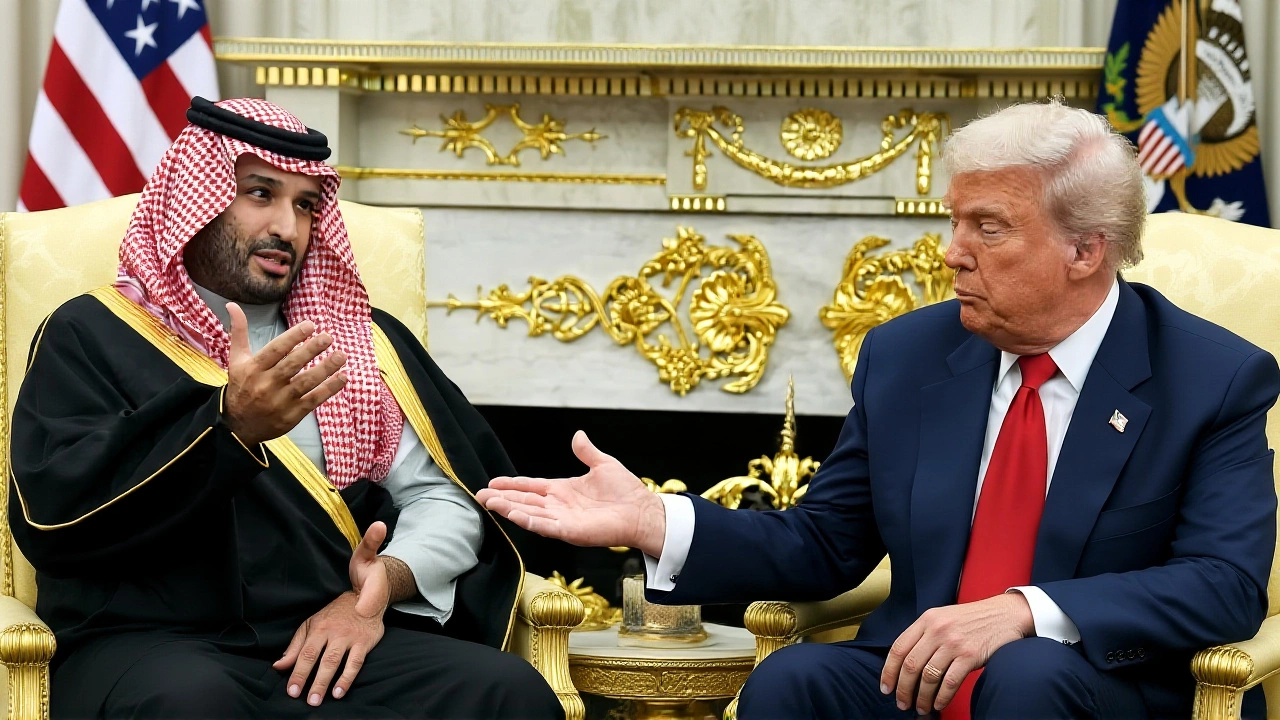
On Tuesday, November 18, 2025, Donald Trump welcomed Mohammed bin Salman, Crown Prince and Prime Minister of the Kingdom of Saudi Arabia, to the White House for a full-day official working visit that blended high diplomacy with unmistakable symbolism. The visit — marked by a bilateral meeting, a private lunch, a black-tie dinner in the East Room, and a farewell on the South Lawn — wasn’t just ceremonial. It was a deliberate signal: the U.S. and Saudi Arabia are deepening their alliance into uncharted territory, far beyond oil and arms.
More Than Just a Dinner: A Strategic Reset
The agenda, as confirmed by the Royal Court of Saudi Arabia and the White House, was unusually broad. Defense ties? Of course. But also artificial intelligence infrastructure, civilian nuclear energy cooperation, and — notably — the potential normalization of relations between Saudi Arabia and Israel. This wasn’t a repeat of 2017. Back then, Trump’s visit to Riyadh was largely about arms deals and counterterrorism. Now, it’s about shaping the future of Middle Eastern tech and security architecture.
That shift matters. Saudi Arabia is pouring billions into AI and clean energy as part of Vision 2030. The U.S., under Trump’s second term, is eager to lock in strategic partnerships before competitors like China or Russia gain ground. The inclusion of nuclear energy talks is especially telling. While Saudi officials have long denied interest in weapons, they’ve openly discussed acquiring peaceful nuclear technology. The U.S. has historically resisted such deals unless paired with strict non-proliferation safeguards. This meeting may have laid groundwork for a new framework — one that could redefine regional power dynamics.
Israel Normalization: The Elephant in the Room
The most politically sensitive item on the table? Saudi-Israeli normalization. Since the 2020 Abraham Accords, Israel has normalized ties with the UAE, Bahrain, Morocco, and Sudan. But Saudi Arabia — the guardian of Islam’s holiest sites — has held back, citing Palestinian statehood as a non-negotiable precondition. Yet in recent months, quiet backchannel talks have intensified. Sources suggest the U.S. offered Saudi Arabia enhanced defense technology, access to U.S. AI research partnerships, and possibly a formal security guarantee in exchange for diplomatic recognition of Israel.
It’s a gamble. Domestically, Saudi Arabia risks backlash from religious conservatives and Arab public opinion. Internationally, it could trigger a realignment in the region. Israel’s Prime Minister Benjamin Netanyahu reportedly sent a private message of appreciation to Trump after the visit, according to U.S. officials familiar with the discussions. The fact that normalization was mentioned alongside AI and nuclear energy suggests it’s no longer a side issue — it’s central.
Behind the Scenes: Who’s Really Driving This?
While Trump and MBS dominated headlines, the real work was done by teams of technocrats. The Executive Office of the President deployed officials from the National Security Council, the Department of Energy, and the Office of Science and Technology Policy. Saudi Arabia sent its own delegation from the Ministry of Energy, the Public Investment Fund, and the National Cybersecurity Authority.
One senior U.S. official, speaking anonymously, said: “They’re not just here for a handshake. They’re here to sign memorandums — quietly — on data-sharing protocols for AI-powered defense systems and joint research centers for nuclear desalination.” That’s not the kind of thing you announce in a press release. It’s the kind of thing that gets buried in classified annexes.
The dinner itself, hosted by Melania Trump in the East Room, was deliberately intimate. No press, no cameras. Just the two leaders, their spouses, and a handful of advisors. The menu? American steak and Saudi lamb, served with dates from Al-Hasa. Symbolism, again, woven into every detail.
Why This Matters Beyond the Headlines
This visit didn’t produce a headline-grabbing deal — no $100 billion arms package, no signed treaty. But that’s the point. The real agreements are being written in technical working groups, not press conferences. The U.S. is betting that Saudi Arabia’s ambition to become a tech and energy hub can be aligned with American interests. And MBS? He’s betting that Washington will keep backing him, even as global opinion grows more critical of his human rights record.
The ripple effects are already visible. Defense contractors like Lockheed Martin and Northrop Grumman are quietly ramping up R&D for joint AI-driven surveillance systems. U.S. universities are preparing proposals for nuclear engineering partnerships with King Abdullah University of Science and Technology. And in Tel Aviv, intelligence officials are mapping out how Saudi airspace might be integrated into regional early-warning networks.

What Comes Next?
No official follow-up summit has been scheduled. But U.S. and Saudi officials confirmed in private briefings that a working group on nuclear energy will convene in Riyadh by January 2026. A separate AI task force will meet in Washington in February. The normalization track, however, remains the most delicate. Sources indicate that U.S. diplomats are now coordinating with Jordan and Egypt to build regional consensus — a necessary step if Saudi Arabia is to normalize relations without triggering a backlash from the Palestinian Authority or Iran.
And then there’s the clock. Trump’s second term ends in January 2029. That’s less than three years to lock in lasting agreements. The urgency is palpable. As one Saudi diplomat put it: “We’re not asking for a forever friend. We’re asking for a partner who won’t disappear after the next election.”
Historical Context: A Relationship That Evolved
The U.S.-Saudi alliance began in 1945, when Franklin Roosevelt met King Ibn Saud aboard the USS Quincy. It was built on oil, then hardened by Cold War anti-communism. After 9/11, the relationship strained. But the 2017 Trump visit — where he called Saudi Arabia “a great partner” and signed $110 billion in arms deals — revived it. Now, with China courting Riyadh on infrastructure and Russia offering military support, Washington is racing to reassert influence.
What’s different this time? The agenda isn’t just about who sells what. It’s about who controls the future. AI. Nuclear energy. Cybersecurity. Space. These aren’t just economic sectors — they’re geopolitical levers. And for the first time, Saudi Arabia isn’t just a buyer. It’s a builder.
Frequently Asked Questions
How does this visit change U.S.-Saudi relations compared to previous administrations?
Unlike past administrations that focused primarily on oil and arms, Trump’s team is integrating Saudi Arabia into U.S. tech and energy strategy. The inclusion of AI and civilian nuclear cooperation signals a shift from transactional deals to long-term institutional partnerships. This mirrors China’s approach with Gulf states but with stronger U.S. security guarantees — something Riyadh increasingly values amid regional instability.
Why is Saudi-Israeli normalization such a big deal?
Saudi Arabia is the most influential Arab state and custodian of Islam’s holiest sites. Its recognition of Israel would break a decades-long consensus that Palestinian statehood must come first. If achieved, it could trigger a cascade of diplomatic shifts across the Arab world, isolate Iran further, and fundamentally alter the balance of power in the Middle East — potentially reducing U.S. military commitments in the region.
What’s at stake with civilian nuclear energy cooperation?
Saudi Arabia wants nuclear power for desalination and electricity, not weapons. But the technology overlap is real. The U.S. has strict non-proliferation rules — no uranium enrichment, no reprocessing. Any deal would require unprecedented transparency, likely including IAEA inspections and U.S. oversight of fuel cycles. If agreed, it would be the most significant nuclear cooperation with an Arab state since the 1970s.
Did this visit result in any concrete agreements?
No formal treaties or financial figures were announced. But multiple U.S. and Saudi sources confirm that classified memoranda of understanding were signed on AI-driven defense systems, joint nuclear research, and cybersecurity protocols. These will be implemented through working groups over the next 12 months, with progress expected to be reported in early 2026 — quietly, without fanfare.
What could derail this partnership?
A major escalation involving Iran, a violent crackdown on dissent in Saudi Arabia, or a U.S. election outcome that shifts foreign policy priorities could all strain the relationship. Additionally, if Saudi-Israeli normalization proceeds without progress on Palestinian statehood, it could spark regional protests and undermine U.S. credibility among Arab publics — a risk both governments are aware of but are betting they can manage.
How does this affect global tech competition?
By tying Saudi Arabia’s AI ambitions to U.S. technology firms and research institutions, Washington is trying to lock out Chinese companies like Huawei and Alibaba from critical infrastructure projects in the Kingdom. With Saudi Arabia investing over $200 billion in its tech sector by 2030, controlling access to AI and data centers is becoming a new front in the U.S.-China rivalry — and Riyadh is playing both sides, for now.